We Spent 3 Weeks Testing 19 Action Cameras to Find the Best for 2026
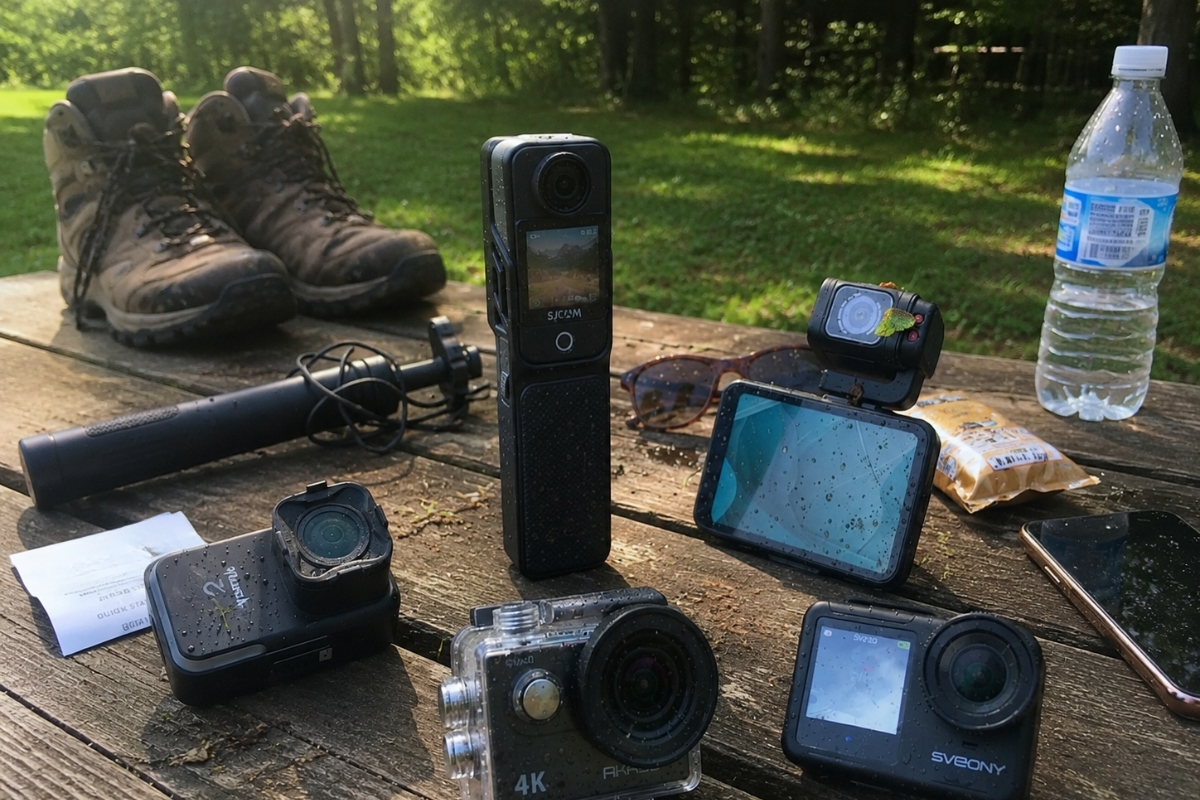
With adventure content creation at an all-time high, a reliable action camera has become as essential as the gear you wear. We spent three weeks testing 19 of the most popular action cameras across surfing, mountain biking, hiking, and underwater scenarios to find the models that actually deliver sharp, stable footage in any environment — without freezing, fogging, or missing the moment.
Our shortlist included models from Bivo, SJCAM, ORDRO, SVBONY, and RunCam. Each camera was put through real-world shooting conditions, stabilization stress tests, and waterproofing evaluations, then scored against four core criteria:
Video Quality & Resolution
We recorded identical scenes at each camera's maximum resolution and compared the footage on a calibrated 4K display for sharpness, color accuracy, dynamic range, and low-light performance — across bright outdoor, shaded, and indoor environments.
Image Stabilization
We mounted every camera on a helmet for mountain bike runs, strapped them to surfboards, and carried them while running, then compared raw and stabilized footage to measure how much shake was removed and whether stabilization introduced cropping or distortion.
Waterproofing & Durability
We submerged each camera to its rated depth, kept shooting in heavy rain, and tested build quality under repeated impacts. We paid particular attention to internal lens fogging after temperature swings — a common failure point that quietly ruins footage.
Battery Life & Ease of Use
We recorded continuously until each battery died at default settings and logged total runtime, then judged the interface, mount compatibility, app connectivity, and how fast each camera could be grabbed and started when a moment arrived without warning.
After three weeks of side-by-side testing, here are the Top 5 Best Action Cameras for 2026.

Michael J. – Outdoor Adventure & Action Camera Specialist
With more than 9 years of hands-on experience testing action cameras and outdoor technology, Michael specializes in evaluating cameras for travel, hiking, watersports, and extreme outdoor activities. He has personally tested dozens of action cameras across different resolutions, stabilization technologies, battery capacities, and waterproofing standards — from casual travelers capturing vacation memories to adventure athletes filming high-speed activities — to identify the models that consistently deliver sharp, stable, high-quality footage in challenging real-world conditions.

1. Bivo ActionShot
from Bivo
Overall Grade
A+
Rating
9.8/10
Overall Analysis
The Bivo ActionShot is the most complete action camera we tested this year — and the gap between it and the rest of the field is significant.
Its standout strength is a 4K30fps video engine paired with genuinely effective electronic image stabilization. While budget cameras fall apart the moment you leave a tripod, Bivo's EIS keeps footage smooth and cinematic whether you're carving down a trail, paddling into a wave, or sprinting across uneven ground. The stabilization avoids the aggressive cropping that makes cheaper cameras feel like you're shooting through a narrow tunnel.
The waterproofing is the most confidence-inspiring in our test group. The Bivo ActionShot is rated to 40 meters without a housing, handles saltwater as well as fresh, and showed zero internal fogging after repeated cold-water-to-warm-air transitions — the exact failure mode that quietly ruins footage on lesser-sealed cameras.
Versatility is genuinely impressive: 4K video, 20MP stills, 1080p120fps slow motion, and time-lapse, all inside a body that slips into a shirt pocket. Wi-Fi lets you preview, transfer, and share clips straight from your phone, and the included mount kit covers helmets, handlebars, chest harnesses, and tripods right out of the box.
With free shipping and a 90-day money-back guarantee, the Bivo ActionShot is the strongest action camera recommendation we've made this year — and the only one that handled every scenario we threw at it without forcing a compromise.
Pros
 4K30fps video with electronic image stabilization — smooth footage on any terrain
- Waterproof to 40m without a case — surf, dive, and swim with no extra housing
- 20MP photo mode — sharp stills alongside high-quality video
- 1080p120fps slow motion — captures every detail of fast action
- Wi-Fi app connectivity — preview and share footage instantly
- Comprehensive mount kit included — helmet, handlebar, chest, tripod
- Compact pocket-size design — take it anywhere
- Battery rated for 90+ minutes of continuous 4K recording
- Voice control — start recording hands-free
- Free shipping included
- 90-day money-back guarantee
Cons
 Often sells out due to high demand
Wrap-Up
The Bivo ActionShot earns the top spot by combining 4K stabilized video, 40-meter native waterproofing, and a genuinely complete mount kit in a pocket-sized body. It was the only camera here that covered every adventure scenario without a trade-off. With free shipping and a 90-day money-back guarantee, trying it is effectively risk-free — whether you're surfing, skiing, biking, or just documenting travel.
2. SJCAM C400 Action Camera
from SJCAM

Overall Grade
B+
Rating
8.5/10
Overall Analysis
The SJCAM C400 is a capable mid-range camera built around real stabilization hardware rather than software-only EIS, which pays off in high-vibration situations like cycling and hiking. SJCAM is an established name in this category, and the C400's 4K footage held up well in bright outdoor light. The compact body and front-facing screen make it a practical choice for vloggers who need to see themselves while filming.
Its limits show elsewhere. Low-light performance was noticeably weaker than the top-tier cameras in this test, and waterproofing depends on the included housing — extra bulk, restricted touchscreen access, and setup time before every water session. It's a reasonable buy for casual creators who value the front screen and stabilizer, but the housing dependency holds it back for serious adventure filming.
Pros
- Built-in hardware stabilizer for smooth footage
- Front-facing screen — practical for vlogging
- Solid 4K performance in bright conditions
- Established SJCAM brand with good support
- Compact, lightweight body
Cons
- Waterproofing requires housing — adds bulk vs. native waterproof alternatives
- Low-light video quality below premium alternatives
- Higher price for a mid-range feature set
- Housing setup adds time before shooting in water
3. ORDRO EP8 Action Camera
from ORDRO

Overall Grade
B
Rating
8/10
Overall Analysis
The ORDRO EP8's standout feature is its 3.5-inch flippable touchscreen — genuinely useful for solo creators who need to frame a shot without a second monitor or a phone. The large display makes reviewing clips in the field easy, and the touch interface beats the button-only controls on most competitors. In controlled, well-lit conditions the 4K footage looked good, and the flip screen worked exactly as intended for vlog-style content.
The trade-offs are physical. The larger body and screen make it bulkier than sport-focused cameras, stabilization lagged behind on high-impact activity, and the big display drained the battery noticeably faster, cutting continuous recording time. It's a solid pick for creators who value the screen, but not the camera to strap to a helmet or a board.
Pros
- 3.5-inch flippable touchscreen — excellent for solo vlogging
- Intuitive touchscreen interface
- Good 4K footage in bright controlled conditions
- High-capacity battery option available
- Practical for studio and travel content creation
Cons
- Bulkier body — not ideal for helmet or board mounting
- Below-average stabilization for high-impact sports
- Battery drains faster due to the large screen
- Less rugged than sport-first alternatives
- Limited waterproofing without housing
4. SVBONY SVGo3 Underwater Camera
from SVBONY

Overall Grade
B-
Rating
7.6/10
Overall Analysis
The SVBONY SVGo3 is a dedicated underwater camera built around long battery life — a sensible niche for divers and snorkelers who need extended submerged recording without surfacing to charge. Its underwater color correction is a practical touch, countering the blue-green shift that flattens footage at depth, and it lasted through longer dive sessions than most cameras here.
Above the waterline it's a different story. Video looked noticeably softer than the competition, stabilization was minimal — fine for slow underwater movement, unusable for surface sports — and the interface was the least intuitive in the test, burying common settings several menus deep. Divers shooting only underwater content may be happy; everyone else will find better all-around value elsewhere.
Pros
- Solid waterproofing for dedicated underwater use
- Extended battery life for long dive sessions
- Underwater color correction feature
- Accessible price point (~$80–$110)
Cons
- Softer video quality above water vs. competitors
- Minimal stabilization — unsuitable for surface sports
- Least intuitive interface in this test
- Limited versatility for general adventure filming
- Slow menu navigation for common setting changes
5. RunCam Remote Action Camera
from RunCam
Overall Grade
C+
Rating
7.1/10
Overall Analysis
The RunCam Remote is built for FPV drone and Cinewhoop mounting, a narrow use case where small size, low weight, and remote triggering matter more than general versatility. Judged on that brief, it does its job: the compact body and remote integration worked exactly as designed on a drone.
Step outside the niche and the limits arrive fast. The small sensor produces visibly softer footage than dedicated action cameras, stabilization is minimal without a gimbal, and there's no native waterproofing, so water activities require a separate housing. The interface assumes remote triggering rather than direct handling. For a general adventure user it's expensive for what it delivers — almost every other camera here offers better footage, better sealing, and easier operation for the money.
Pros
- Ultra-compact size ideal for FPV drone mounting
- Remote control triggering for drone applications
- Lightweight — minimal impact on drone flight performance
- Designed for Cinewhoop and racing quad use
Cons
- Softer footage than dedicated action cameras
- Minimal stabilization without an external gimbal
- No native waterproofing — requires separate housing
- Interface designed for remote control, not direct use
- High price for limited general-purpose value
What is an Action Camera?
An action camera is a compact, rugged camera built to record high-quality video while mounted to a helmet, board, bike, chest harness, or drone. Unlike a smartphone, it's designed to survive water, dust, vibration, and impact while stabilizing footage on the move — so you can capture the moment instead of protecting your gear.
Benefits of a High-Quality Action Camera
- Capture every adventure in 4K — cinema-quality footage a phone camera can't match
- Shoot anywhere without worry — native waterproofing means no housing, no setup delays
- Share instantly — Wi-Fi connectivity transfers and posts footage from the field in seconds
- Mount it anywhere — universal compatibility covers helmets, boards, bikes, and chest rigs
- Never miss a moment — voice control and one-button start capture the action immediately
What to Look For When Choosing an Action Camera
Native waterproofing vs. housing
Cameras sealed from the factory can go straight into water with no preparation. Housing-dependent models add bulk, block touchscreen access, and require setup before every water session. For serious water sports or spontaneous shooting, native waterproofing is far more practical.
Stabilization type and effectiveness
Electronic image stabilization handles moderate vibration well and adds no physical bulk. Optical or hardware stabilizers cope better with extreme vibration but add weight. For most adventure sports, a well-implemented EIS system produces footage smooth enough for professional use.
Resolution vs. frame rate
4K at 30fps gives the sharpest footage for standard playback, while 1080p at 120fps unlocks 4x slow motion for fast action. The most versatile cameras offer both — check you can switch modes without digging through menus.
Battery life and charging
Action cameras drain batteries fast, especially at 4K. Check continuous recording time at your primary resolution, and favor USB-C charging with swappable batteries for long days away from power.
Mount and accessory ecosystem
A camera is only as useful as its mounting system. Confirm the included mounts cover your main use cases, and check whether it uses GoPro-compatible slots — by far the widest accessory ecosystem available.
What to Avoid When Choosing an Action Camera

Cameras that need housing for basic waterproofing
If water is part of your routine, a housing-dependent camera is friction that will cost you shots. Native waterproofing rated to at least 10 meters is the minimum for surfing, kayaking, or swimming.
Overinflated resolution claims
Plenty of budget cameras advertise 4K achieved through interpolation rather than a true 4K sensor. Interpolated footage looks visibly softer — confirm native 4K capture before buying.
Single-battery cameras with no swap option
On a full-day adventure, a camera you can't re-battery leaves you stranded mid-session. Check that spare batteries exist and are affordable before committing to an ecosystem.
Michael J. – Outdoor Adventure & Action Camera Specialist
With more than 9 years of hands-on experience testing action cameras and outdoor technology, Michael specializes in evaluating cameras for travel, hiking, watersports, and extreme outdoor activities. He has personally tested dozens of action cameras across different resolutions, stabilization technologies, battery capacities, and waterproofing standards — from casual travelers capturing vacation memories to adventure athletes filming high-speed activities — to identify the models that consistently deliver sharp, stable, high-quality footage in challenging real-world conditions.