We Spent 3 Weeks Testing 19 EMF Meters to Find the Best for 2026
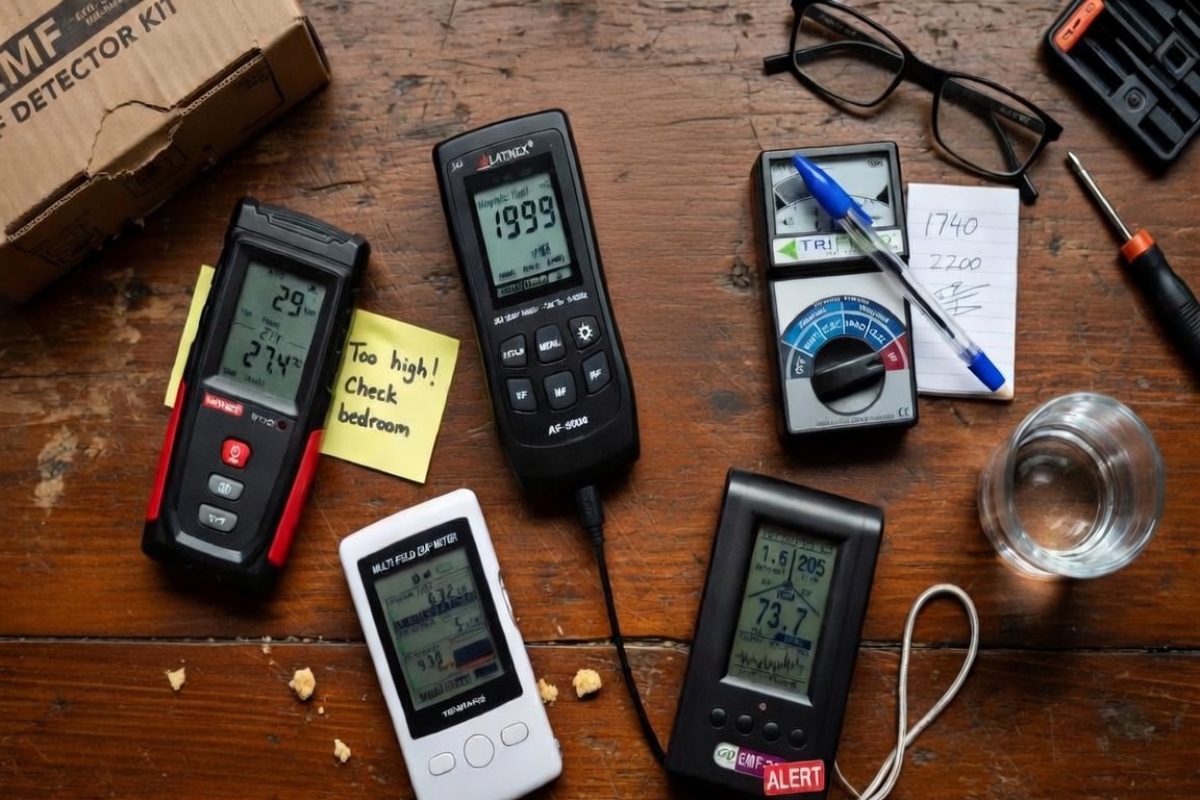
Almost nobody has actually measured the electromagnetic fields inside their own home — and almost everybody is surprised the first time they do. A good EMF meter does more than display a number. It shows you which corners of the house are quiet, which are not, and gives you something concrete to act on when you decide where to sleep, work, or put a child's desk.
Over three weeks we put 19 of the most widely sold EMF meters of 2026 through the same routine — from Bivo, TriField, GQ, LATNEX, and TENMARS — sweeping the same homes, offices, and vehicles with each one. We wanted to know which meters produce readings you can trust and act on, and which simply produce readings. Five criteria decided the rankings:
Detection Accuracy & Sensitivity
Every meter was checked against calibrated laboratory reference instruments at known field strengths, on each field type it claims to support. Anything drifting more than ±10% from the reference at normal household exposure levels lost points, no matter how good the rest of the device was.
Multi-Field Coverage
We recorded which of the three field types each meter actually reads: RF radio frequency, ELF electric, and ELF magnetic. A meter that nails one field but ignores the other two still hands you an incomplete picture, so single-field devices were scored accordingly.
Ease of Use & Display
We handed each meter to first-time users and timed how long it took them to get a reading they understood. Display legibility, audio alerts, and how much menu-diving a simple scan required all fed into this score.
Build Quality & Portability
Construction, weight, size, and power source all counted. Meters running on disposable batteries scored below rechargeable ones, and every unit spent time in a pocket and a glovebox to see how it held up to ordinary handling.
Value & Reliability
Price only matters next to performance, so we weighed each meter's cost against what it proved it could do in testing — and against whether a money-back guarantee protects you if it underperforms in your particular home.
After three weeks and 19 models, these are the five best EMF meters of 2026.

Thomas O – Electronics Safety & EMF Research Specialist
Thomas has spent over 12 years researching electromagnetic fields and electronic safety in residential, workplace, and automotive environments. He has personally tested and evaluated dozens of EMF meters and detection devices, assessing measurement accuracy, frequency range, sensitivity, ease of use, and real-world reliability across homes, offices, and vehicles to help consumers better understand and evaluate electromagnetic field measurements.

1. Bivo EMFSense Pro
from Bivo
Overall Grade
A+
Rating
9.8/10
Overall Analysis
The Bivo EMFSense Pro won our 2026 test outright, and it did so by refusing the compromise every other meter here asks you to make. Most devices are either accurate or approachable — this one is both. It reads RF, ELF electric, and ELF magnetic fields to within ±5% of our laboratory reference instruments, yet the entire interface is a single button and an AudioAlert™ tone that rises as you approach a source. Anyone can pick it up and sweep a room properly on their first try.
That combination mattered in practice. Working through real houses, the Bivo EMFSense Pro flagged hotspots beside routers, smart meters, and kitchen appliances that single-field meters walked straight past — the kind of blind spot that leaves you falsely reassured. The USB-C battery lasts a full afternoon of scanning and removes the disposable-battery habit entirely, the backlit display stays legible in a dim basement or bright yard, and the 90-day money-back guarantee means the only real way to evaluate it — in your own home — costs you nothing.
Pros
 Detects all three EMF field types: RF, ELF electric, and ELF magnetic in one device
- AudioAlert™ system — audio alarm plus LED indicator when readings exceed threshold
- Real-time backlit digital display with precise numerical readings, updated every second
- Verified to within ±5% of laboratory reference instruments across all field types
- Single-button operation — no menus, no calibration, no setup required
- USB-C rechargeable — up to 8 hours per charge, no disposable batteries
- Pocket-sized and under 6 oz — scans rooms, vehicles, and offices with ease
- Covers all common sources: WiFi, 5G, smart meters, appliances, power lines
- Built-in EMF safety reference guide
- Ships within 1–2 days
- 90-day money-back guarantee — zero risk
- No monthly fees or subscriptions
Cons
 Only available directly from Bivo's website, not in retail stores
Wrap-Up
The Bivo EMFSense Pro takes the top spot because it fixes the flaw running through the rest of this field: partial detection. Three-field coverage, an audio alert you can hear from across the room, and one-button operation make it the only meter here we would recommend without a caveat attached — whether it is your first meter or a replacement for one that never quite made sense. With 90 days to return it, verifying that in your own home costs nothing but the time.
2. LATNEX AF-5000 5G EMF Meter
from LATNEX

Overall Grade
A
Rating
9/10
Overall Analysis
The LATNEX AF-5000 is built for people worried specifically about 5G. Its frequency range reaches higher than most rivals here, and every unit ships with a factory calibration certificate — genuinely useful if you need documented figures for a report, a landlord, or a client rather than just personal peace of mind.
On the sources most people actually care about, though, the premium is hard to justify. Against routers, smart meters, and appliances the AF-5000 measured no better than meters costing considerably less. Its menu structure is more involved than a home scan warrants, readings take noticeably longer to settle than the faster-refreshing competition, and the body is too bulky to carry comfortably around a house. A sound professional tool; an expensive one for a homeowner.
Pros
- Includes factory calibration certificate for documented accuracy
- Extended frequency range covering 5G bands
- All three field types detected
- Data hold function
- Recognized in professional inspection circles
Cons
- Price premium not matched by performance gains for typical home use
- Slower reading refresh rate than competitors
- Complex interface with a steeper learning curve
- Bulkier than alternatives at this price point
- Calibration certificate unnecessary for most home users
3. EMF Meter Advanced GQ EMF-390
from GQ

Overall Grade
B
Rating
8.7/10
Overall Analysis
No meter in this test packs in more than the GQ EMF-390. It reads several field types at once, logs measurements internally, exports them over USB, and covers one of the widest frequency ranges you will find at the price. If your goal is to track a room's EMF profile over weeks and study the trend, nothing else here comes close.
All that capability has a cost, and it is paid in usability. The multi-mode menu is not something you work out on the spot — the manual is required reading — and the large, squared-off body makes casual room-to-room sweeping a chore. Magnetic and RF readings held up well in our checks; electric field readings wandered more than we would like. Ideal for a technically minded owner who wants data. Considerably more meter than most households need.
Pros
- Internal data logging — records readings over time for trend analysis
- USB connectivity for data export to a computer
- Wide frequency detection range including higher RF bands
- Simultaneous multi-field display
- Rechargeable via USB
Cons
- Complex multi-mode menu system — requires manual reading before first use
- Large, bulky form factor — less comfortable for extended scanning
- Electric field readings less consistent than competitors in testing
- Data logging features unnecessary for typical home use
- Display cluttered with information — harder to read at a glance
4. TriField EMF Meter Model TF2
from TriField
Overall Grade
C
Rating
8.7/10
Overall Analysis
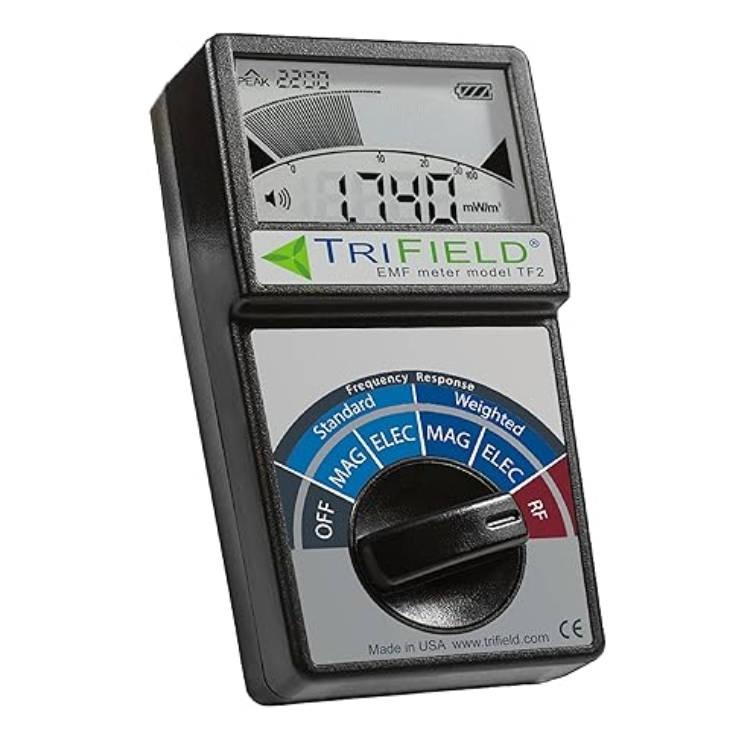
The TriField TF2 has been the reference point in residential EMF work for years, and it earned that status honestly: it is still the most accurate magnetic field meter we tested. Its weighted mode — which scales readings the way the human body responds to different magnetic frequencies — is a genuinely clever piece of design, and it explains the loyalty it commands among building biologists and home inspectors.
Put it in an ordinary household, though, and its age shows. The analog needle takes practice to read and is easy to misjudge at a glance. It runs on AAA batteries, which means a recurring cost and the occasional dead meter halfway through a scan. It is also among the most expensive options here, with an interface that asks more of a beginner than most beginners want to give. Superb for magnetic precision; awkward as an all-round tool for scanning a whole house.
Pros
- Industry-recognized accuracy for magnetic field detection
- Unique weighted mode mimics biological EMF response
- Covers magnetic, electric, and radio/microwave fields
- Established track record among professional inspectors
- Peak hold function captures transient spikes
Cons
- Analog needle display requires interpretation — not instantly readable
- Runs on AAA batteries — no rechargeable option
- Higher price point than comparable modern alternatives
- Steeper learning curve for first-time users
- No audio alarm on standard magnetic/electric modes
5. TENMARS Multi-Field EMF Meter Pocket
from TENMARS

Overall Grade
D
Rating
8.6/10
Overall Analysis
The TENMARS is the cheapest way into three-field EMF measurement. It is small, simple, and costs a fraction of everything above it, which makes it a reasonable pick if all you want is a rough sense of what is happening around your router, smart meter, or microwave.
Ask more of it and the limits appear quickly. It produced the widest spread of repeat readings of any meter in the group, and the inconsistency was worst at low field strengths — exactly where a small difference changes your conclusion. With no audio alarm you have to watch the screen continuously, which rules out any methodical sweep of a room, and the display fights you in both dim and bright light. Fine for the occasional spot check, but not a meter to base decisions on.
Pros
- Lowest price point of the group
- Compact pocket-sized design
- Covers all three EMF field types
- Simple single-mode operation
- Lightweight for easy carry
Cons
- Most variable accuracy of the group — especially at low field levels
- No audio alarm — requires constant screen-watching during scans
- Display harder to read in low-light or bright-light conditions
- Cheaper plastic construction compared to competitors
- Not suitable for systematic documentation or professional use
What is an EMF Meter?
An EMF meter is a handheld instrument that measures the strength of electromagnetic fields around you. A complete picture takes three separate measurements: radio frequency from WiFi routers, mobile networks, and smart devices; ELF electric fields radiating from household wiring; and ELF magnetic fields from power lines, transformers, and appliances. A meter covering all three tells you what you are actually living with. One covering a single field type can leave the strongest source in the house entirely invisible.
Benefits of an EMF Meter
- Find the hidden sources — routers, smart meters, appliances, wiring runs, and power lines — room by room at home and at work
- Decide where the bed, the desk, and the children's play area go based on measurements rather than guesswork
- Read all three field types — RF, electric, and magnetic — from one device that fits in a pocket
- Confirm whether shielding or simply moving a device actually lowered the reading
- Check hotel rooms, rentals, and cars before you spend long stretches of time in them
- Sweep a room by ear with audio alerts instead of walking around staring at a screen
- Skip disposable batteries entirely with a rechargeable model
- Build a repeatable record of your home's EMF profile you can compare against later
Things To Consider When Choosing an EMF Meter
Detection accuracy
A meter is worth exactly as much as its accuracy. Look for one verified against laboratory reference instruments, ideally holding within ±5–10% on every field type it claims to measure.
Field types covered
Budget meters often read magnetic fields only. A real assessment needs RF, ELF electric, and ELF magnetic together — miss one and you may miss the loudest source in the room.
Audio alarm functionality
Without an audio alert, every scan means staring at the display while you walk. A tone that rises near a source lets you sweep freely and glance down only when something registers.
Battery type and life
USB-rechargeable meters cut out disposable battery costs and never die halfway through a survey. Six to eight hours per charge is enough to cover a whole house in one go.
Display clarity
A backlit digital readout is far quicker to interpret than an analog needle, and far harder to misread. Look for one that refreshes at least once a second so the number keeps up with you.
What To Avoid When Choosing an EMF Meter

Single-field meters
Plenty of cheap meters detect magnetic fields and nothing else. They will show a clean bill of health while ignoring the RF from your router, the 5G tower down the street, your smart devices, and the microwave — most of modern exposure, in other words. Check for all three field types before you buy.
Uncalibrated budget meters
A meter with no verified accuracy can read far above or far below reality, which either frightens you over nothing or reassures you when it should not. Insist on published lab-tested accuracy figures, and independent verification where you can find it.
No audio alarm
A meter that has to be watched cannot be used properly. Without an audio alert you are forced to choose between reading the screen and moving through the room, and a thorough survey needs both at once.
Thomas O – Electronics Safety & EMF Research Specialist
Thomas has spent over 12 years researching electromagnetic fields and electronic safety in residential, workplace, and automotive environments. He has personally tested and evaluated dozens of EMF meters and detection devices, assessing measurement accuracy, frequency range, sensitivity, ease of use, and real-world reliability across homes, offices, and vehicles to help consumers better understand and evaluate electromagnetic field measurements.